
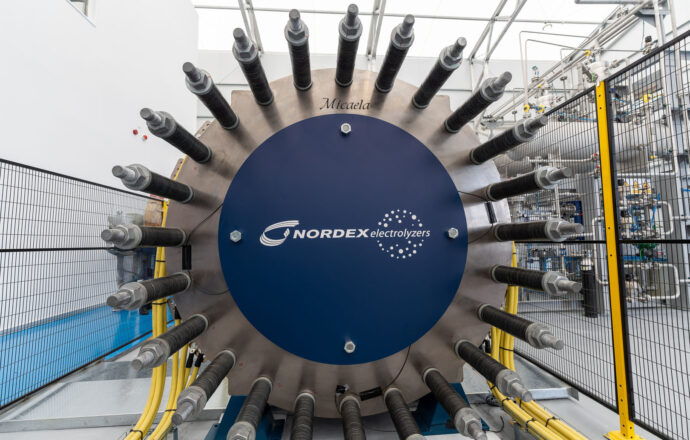
Our members Nordex Electrolyzers and Alaz Arima have technically validated a new cooling solution for electrolysers within the RECAFEL project. The approach is based on passive phase-change cooling systems, known as thermosiphons, capable of transporting heat naturally, without pumps or auxiliary equipment that consume energy.
Cooling electrolysers currently requires auxiliary equipment that consumes electricity and adds complexity to the system. Unlike conventional water-recirculation circuits, the thermosiphon dissipates heat through the evaporation and condensation of a fluid, with no additional pumps or maintenance. The result is more efficient, reliable and sustainable electrolysers, and a more competitive production of renewable hydrogen.
RECAFEL began at the end of 2024 with funding of 243,250 euros from the Government of Navarre and the European Regional Development Fund (ERDF). The project has made it possible to research and validate the technology as a step prior to its commercial deployment, with the aim of optimising technical performance and significantly reducing operating costs.
The general manager of Nordex Electrolyzers, Luis Solla, has stressed that this is a proposal that is simple in appearance but of great technical complexity, one that could bring a qualitative leap in the cooling of electrolysers and open up new industrial applications in a hydrogen sector that is expanding rapidly.
Nordex Electrolyzers, owned by Sodena and the Nordex Group, designs, manufactures and installs pressurised alkaline electrolysers for green hydrogen. Alaz Arima, based in Pamplona, specialises in passive cooling systems for renewable energy and electric mobility. The collaboration between the two companies opens the door to new industrial applications and to greater competitiveness in the green hydrogen sector.